

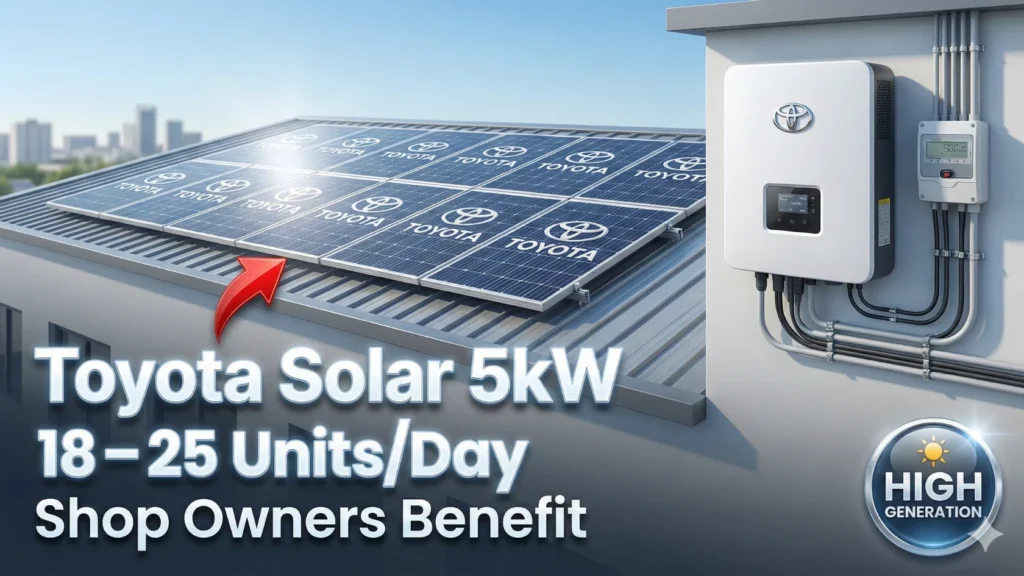
Toyota Solar Panels: Electricity cost is a daily headache for middle-class shop owners because lights, fans, fridge, CCTV, and signage run for long hours and the bill hits every month without mercy. A 5kW rooftop setup becomes attractive when the generation target is clear, and the daily 18–25 units number is exactly what makes this topic click. At 18–25 units per day, monthly generation sits around 540–750 units, which can reduce the bill heavily for shops that consume power mostly in daytime. This setup works best when the shop’s highest load happens during sunlight hours, because direct self-use gives maximum savings.
System and installation quality
A 5kW system is usually built using 9 panels of 540–550W or 10–12 panels in the 400–450W range, paired with a 5kW grid-tied inverter, mounting structure, DC/AC wiring, and protection devices. Roof space required stays around 300–450 sq ft depending on panel wattage and spacing. Mounting must be rust-protected and anchored for wind safety, because commercial rooftops face high wind and heat stress. Proper earthing, surge protection, and clean cable routing reduce inverter shutdown risk.
Daily generation and savings
A 5kW setup producing 18–25 units per day equals 540–750 units per month. If the tariff is ₹8 per unit, the monthly value becomes ₹4,320–₹6,000. If the tariff is ₹9 per unit, it becomes ₹4,860–₹6,750. For shop owners, the best-case scenario is direct daytime usage because it offsets billed units immediately without waiting for billing adjustments. High daytime loads like fridge, deep freezer, and machine usage match solar generation timing, which is why shops see faster savings compared to homes with night-heavy consumption.
Net metering and output factors
Net metering decides how much value you extract when generation exceeds usage at certain hours. If the shop closes early or load drops mid-day, net metering credits exported units and protects savings. Output depends on shading, dust, tilt, and temperature, and even partial shadow from a nearby wall or hoarding can reduce total generation sharply. Cleaning every 10–20 days is practical for shops in dusty market areas because dust directly cuts output. A realistic planning number for stable monthly value is 540–650 units, not the peak month figure.
Warranty, maintenance and safety
Panels generally carry long performance warranties, while inverters usually come with 5–10 years coverage depending on model. Maintenance is mostly cleaning and periodic electrical inspection because there is no battery in a standard grid-tied system. Safety must include DC isolator, AC MCB, surge protection, and proper earthing to reduce shock and fire risk. Grid-tied systems shut down during power cuts, so if a shop needs backup for billing counter or CCTV, a hybrid inverter plus battery is required.
Price and EMI shock
A Toyota 5kW rooftop solar setup is expected to cost between ₹2.40 lakh and ₹3.30 lakh depending on panel wattage, inverter grade, structure quality, and wiring, and EMI can start at ₹5,499 per month with a ₹45,000 down payment on a 60-month plan, while a higher package near ₹3.30 lakh can sit around ₹7,499 EMI with a ₹60,000 down payment on the same tenure. With 540–750 units monthly generation and ₹8–₹9 per unit tariff, monthly savings value stays around ₹4,320–₹6,750, which is why many shop owners see 5kW solar as a business expense that pays itself back through reduced bills.

