

Samsung Solar Panels: Corporate offices in India are shifting toward rooftop solar because daytime electricity consumption is the exact period when solar generates the most. A 50kW rooftop setup becomes attractive when it can cover up to 60% of daytime load, because that directly reduces the highest-tariff working-hour consumption for lighting, HVAC support, servers, lifts, and office equipment. This size is discussed for corporate buildings that run 9–10 hours per day and want predictable savings without changing operations. The real outcome depends on roof space, sanctioned load, daylight hours, and whether net metering is approved for export credits.
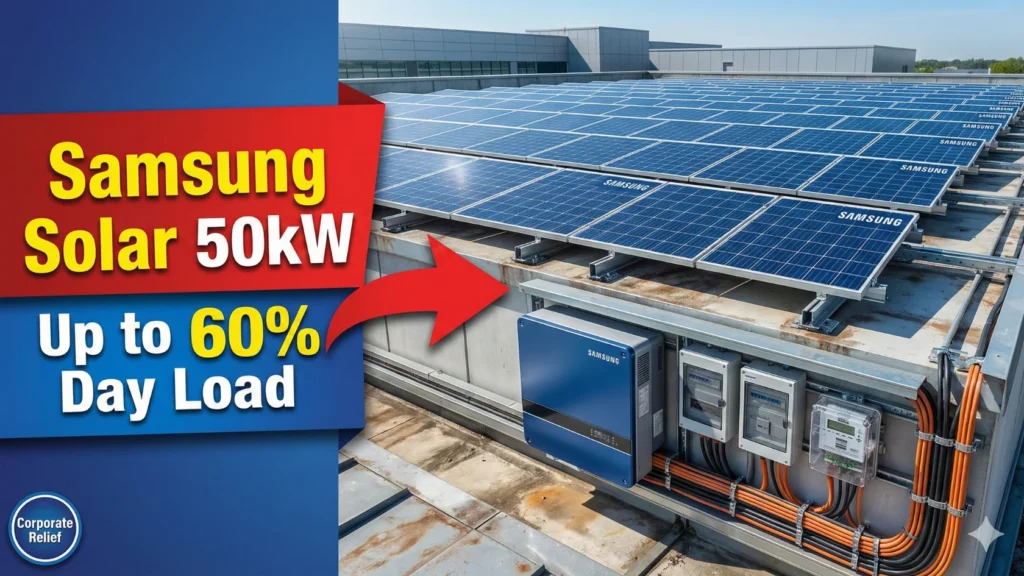
System and installation quality
A 50kW system is typically built with around 90–95 panels of 540–550W or 110–125 panels of 400–450W, paired with a 50kW grid-tied inverter or multiple string inverters, plus mounting structure, DC/AC cabling, and protection devices. Rooftop area required usually sits around 4,000–6,000 sq ft depending on panel wattage and walkway spacing. Structure must be engineered for wind load and waterproofing integrity. Proper earthing, lightning arrester integration, and surge protection are critical at this capacity.
Daily generation and savings
A 50kW rooftop system in many Indian cities can generate around 180–250 units per day depending on sunlight and season, which equals about 5,400–7,500 units per month. If the blended commercial tariff is ₹10 per unit, the monthly value becomes ₹54,000–₹75,000. If the tariff is ₹12 per unit, it becomes ₹64,800–₹90,000. For offices, savings are stronger when most generation is consumed in real time because HVAC and equipment loads run during sunlight hours. That is how “up to 60% daytime load coverage” becomes realistic in many corporate profiles.
Net metering and output factors
Net metering matters when generation exceeds load during weekends, holidays, or low-occupancy days. Export credits protect savings and reduce wastage, but policies differ by DISCOM and state. Output is sensitive to shading from lift rooms, parapet walls, or nearby towers, so layout planning and string design are critical. Dust can cut generation, so cleaning cycles are usually set weekly or bi-weekly depending on pollution levels. For corporate planning, a conservative average of 5,800–6,800 units per month reduces forecasting risk.
Warranty, maintenance and safety
At 50kW scale, maintenance becomes a scheduled facility task. Panels generally carry long performance warranty terms, while inverters often carry 5–10 years depending on model and AMC coverage. Safety must include DC isolators, AC breakers, surge protection devices, and proper earthing across the plant. Lightning protection is important because a single surge event can damage multiple strings. Grid-tied solar shuts down during power cuts, so backup needs remain separate through DG or battery systems where required for servers and critical operations.
Price and EMI shock
A Samsung 50kW rooftop solar setup is expected to cost between ₹20.00 lakh and ₹28.00 lakh depending on panel type, inverter architecture, structure grade, cable specifications, and safety equipment, and EMI can start around ₹45,999 per month with a ₹3.00 lakh down payment on a 60-month plan, while a higher-end package near ₹28.00 lakh can sit around ₹61,999 EMI with a ₹4.50 lakh down payment on the same tenure. With 5,400–7,500 units per month generation and ₹10–₹12 per unit tariff, the monthly savings value stays around ₹54,000–₹90,000, which is why many corporate offices treat 50kW solar as a bill-control investment that improves operating margins.

