

Maruti WagonR EV: India’s middle-class car market reacts fastest when a familiar badge gets an EV story attached to it, and the WagonR EV launch buzz is exactly that trigger. The 450Km range claim pulls attention because it sounds like petrol-level freedom in a city-friendly footprint, and the rugged looks angle targets buyers who want an SUV-style stance without paying SUV money. The panic-search behaviour is simple math: one car that promises low running cost and long range can cut monthly fuel stress for families doing school, office, and weekend travel in one loop. These are launch claims, so the real impact depends on final battery size, charging time, and variant pricing.
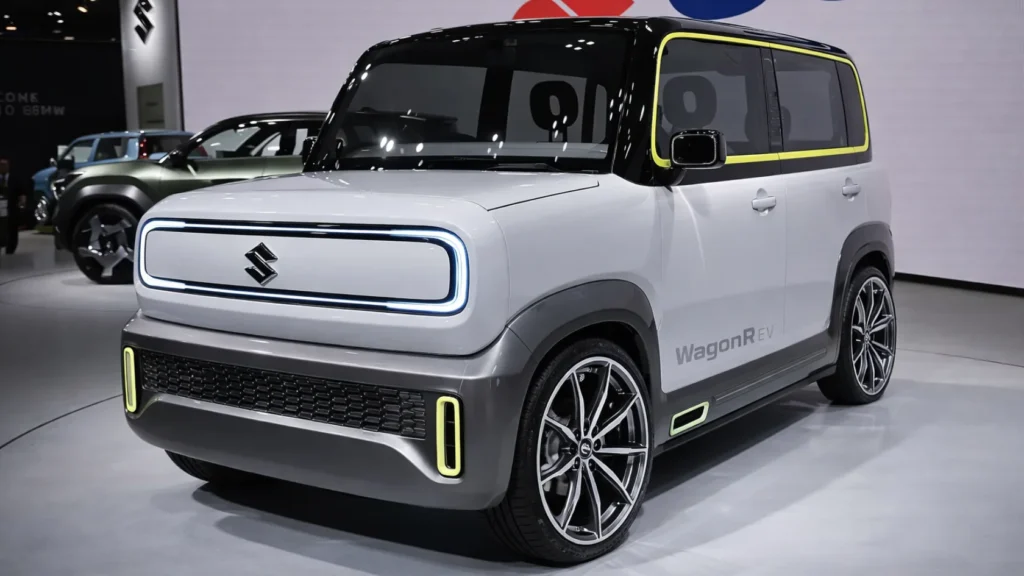
Design and Build Quality
A rugged-looking WagonR EV will be judged on tall seating, practical entry, and a body structure that stays tight over rough roads. Build quality matters because a family car sees daily door usage, frequent speed breakers, and constant cabin movement. Underbody protection becomes critical in an EV because battery placement sits low, so stone hits and water splash protection decide long-term safety. A higher stance look must still keep stability at 80–100Km/h, and tyre choice must match the extra weight that an EV battery adds. Cabin practicality is the WagonR identity, so storage pockets, rear seat comfort, and visibility will decide acceptance.
Range and Charging
The 450Km range claim changes the weekly charging routine for typical urban families. At 35Km per day, 450Km equals 12.8 days per charge, and at 50Km per day it equals 9 days per charge on paper. Real-world range depends on AC usage, traffic, speed, tyre pressure, and load, so a practical window matters more than the best-case figure. Charging time decides convenience because a large range number usually means a larger battery, and a larger battery takes longer to refill. Without exact 10–80% time, peak DC kW support, and AC home charging hours, range alone cannot define usability.
Performance and 100Km/h Speed Reality
A WagonR EV will be judged on smooth low-speed torque and easy city driving, not track numbers. Quick response from 0–40Km/h helps in traffic gaps, while stability at 70–100Km/h matters for flyovers and highways. EV weight changes braking distance, so braking feel and tyre grip decide driver confidence. Thermal management matters because Indian summer traffic can push battery and motor temperatures high, and power delivery must stay consistent with AC running. For middle-class buyers, performance means predictable driving and low fatigue, not aggressive speed.
Features and Safety Features
A mass-market EV needs useful features that support ownership. A clear digital display with range in Km, battery percentage, and charging status is mandatory. Safety expectations include ABS, ESC where offered, airbags by variant, strong braking hardware, and stable tyres. Practical EV features like regen levels, scheduled charging, and accurate range prediction improve daily planning. Service readiness matters more than fancy screens, because middle-class ownership depends on quick repairs and predictable costs, especially in Tier-2 cities.
Price and EMI Shock
Maruti WagonR EV is expected to be priced between ₹10.50 lakh and ₹13.50 lakh depending on battery and variant. EMI plans could start around ₹16,999 per month with a ₹1.25 lakh down payment on a 60-month plan, while higher variants can push EMI near ₹20,999 per month with a ₹1.50 lakh down payment on the same tenure. At this price, a running cost of around ₹1.00–₹1.40 per Km is possible with ₹8 per unit electricity and a 320–450Km real-use range window, which stays far below petrol running cost for high-usage families. If Maruti matches these numbers with strong after-sales support and consistent charging performance, it can pull a large share of budget petrol hatchback buyers into the EV side quickly.

