

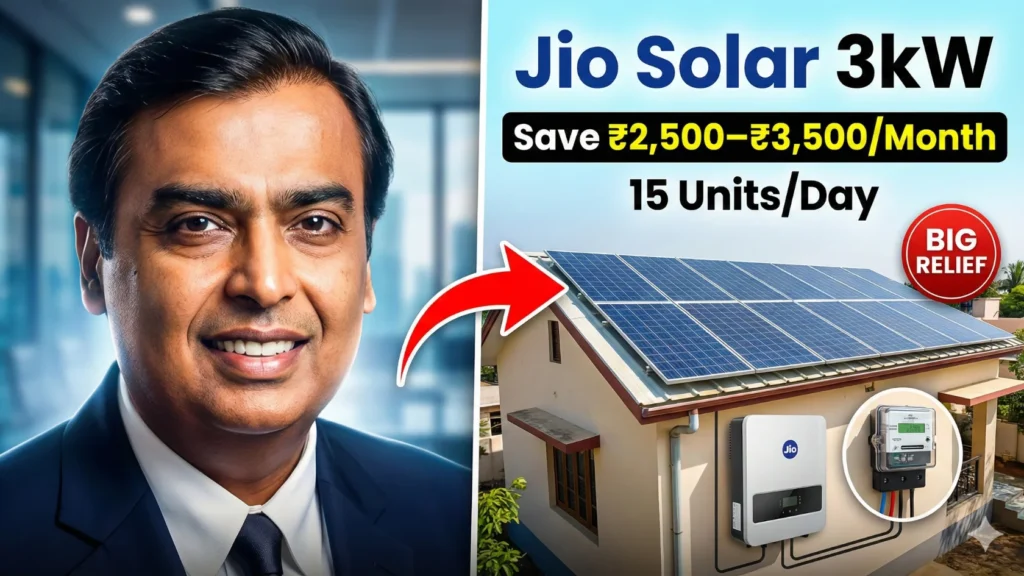
Jio Solar Panels: Rooftop solar is being adopted faster in Indian cities because a 3kW setup converts a painful electricity bill into a predictable monthly saving number. Jio Solar Panels in the 3kW bracket are being searched because the saving target is clear for middle-class homes: ₹2,500–₹3,500 per month without cutting daily comfort. This size supports common daytime loads like fans, lights, fridge, TV, router, and limited AC usage when sunlight is strong. The savings depend on your unit rate, city sunlight hours, net metering approval, and how much of the generation you consume in the day versus exporting to the grid.
System and installation quality
A 3kW rooftop system is usually built with 6 panels of 540–550W or 7–8 panels of 375–450W, a 3kW grid-tied inverter, mounting structure, DC/AC cabling, and protection devices. Rooftop area required stays around 180–250 sq ft depending on panel wattage and spacing. Structure must be rust-protected and anchored properly for wind safety. DC cable must be UV-rated and routed inside conduit. Proper earthing and surge protection reduce inverter damage risk during storms and voltage spikes.
Daily generation and savings
A 3kW setup typically generates around 10–15 units per day in many Indian cities, which equals 300–450 units per month across seasons. If your tariff is ₹8 per unit, 300 units equals ₹2,400 and 450 units equals ₹3,600 monthly value, which fits the ₹2,500–₹3,500 saving band for many homes. If your tariff is ₹9 per unit, the same output becomes ₹2,700–₹4,050. Summer months usually sit higher, while monsoon weeks reduce generation. Daytime self-use increases savings because it offsets billed units directly.
Net metering and output factors
Net metering decides whether surplus daytime units reduce the bill or get wasted. Homes that stay empty in daytime benefit more from net metering because exported units get adjusted in monthly billing. Output depends on shading, dust, tilt angle, and rooftop temperature. Shading from a water tank for even 1–2 hours can cut monthly generation sharply, so layout planning matters. Cleaning every 15–30 days in dusty areas protects output. A realistic planning number for stable savings is 300–400 units per month, not the best-case peak month.
Warranty, maintenance and safety
Panels usually come with long performance warranty terms, while inverters typically carry 5–10 years depending on model. Maintenance is mostly cleaning and a yearly electrical inspection because grid-tied systems have no battery replacement cost. Safety must include DC isolator, AC MCB, surge protection device, and proper earthing to reduce shock and fire risk. Grid-tied systems shut down during power cuts, so backup comfort needs a hybrid inverter and battery. Service response time matters because one inverter fault can stop generation completely.
Price and EMI shock
A 3kW Jio solar setup is expected to cost between ₹1.45 lakh and ₹2.05 lakh depending on panel wattage, inverter model, structure quality, and wiring grade, and EMI can start at ₹3,499 per month with a ₹25,000 down payment on a 60-month plan, while a higher package near ₹2.05 lakh can sit around ₹4,999 EMI with a ₹35,000 down payment on the same tenure. With 300–450 units per month generation and ₹8–₹9 per unit tariff, the saving value stays around ₹2,400–₹4,050 per month, and that is why middle-class homes treat 3kW solar as bill relief that pays back within a practical ownership cycle.

