
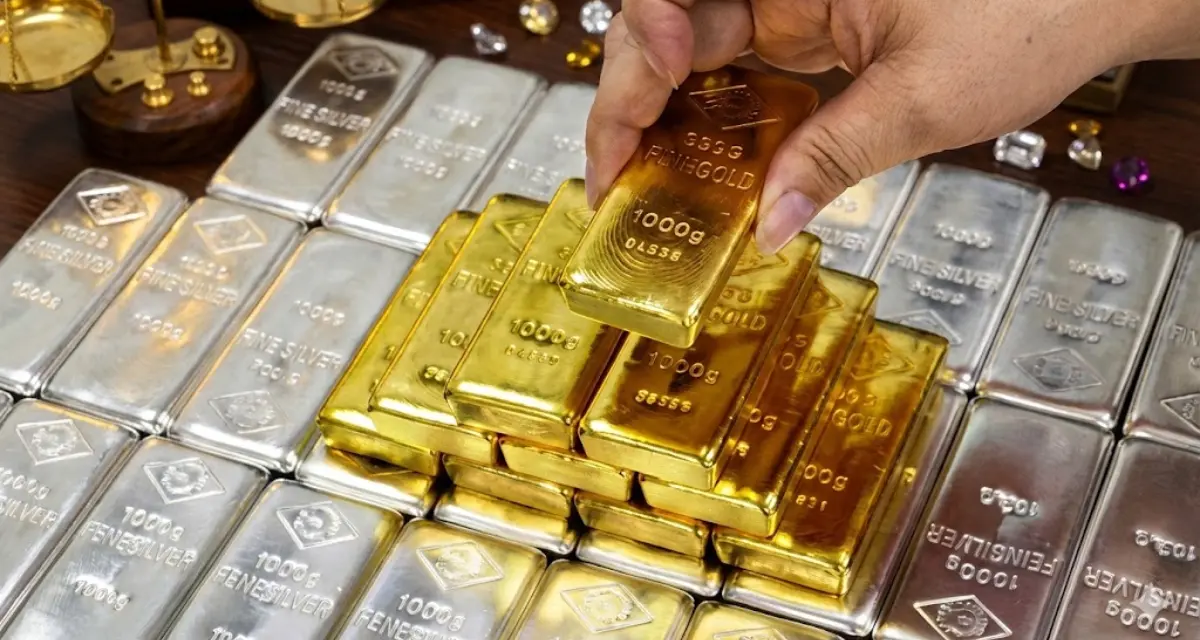
The recent gold and silver price crash has shaken global commodity markets after a long period of strong gains. Precious metals, which were trading near record highs, suddenly witnessed heavy selling pressure, surprising many investors who viewed gold and silver as stable safe-haven assets.
This sharp correction has raised important questions about whether the rally is over or if the current fall is only a temporary pause before the next move. Market participants are now closely watching economic signals to understand the post-crash roadmap for precious metals.
Why Gold and Silver Prices Fell Suddenly
The gold and silver price crash came after an extended rally where prices had already climbed rapidly. Such strong upward moves often lead to profit booking, and that is exactly what triggered the sudden sell-off. Investors who entered early chose to lock in gains, increasing selling pressure across metal markets.
Another key factor behind the fall was changing expectations around global interest rates. When interest rates are expected to stay higher for longer, non-yielding assets like gold and silver tend to lose short-term appeal. A stronger global currency environment also added pressure on metal prices.
Market Volatility and Investor Sentiment
Precious metals are highly sensitive to investor psychology, and silver is known to be even more volatile than gold. During periods of rapid price movement, market sentiment can shift very quickly from optimism to caution. This change in sentiment played a major role in accelerating the recent crash.
Short-term traders reacted aggressively to price weakness, while long-term investors adopted a wait-and-watch approach. As volatility increased, uncertainty dominated the market, leading to sharp intraday swings in both gold and silver prices.
Long-Term Outlook for Gold After the Crash
Despite the recent correction, the long-term outlook for gold remains relatively stable. Gold continues to be viewed as a hedge against economic uncertainty, inflation risks and global instability. Central bank demand and long-term investment interest still support gold prices at lower levels.
However, in the near term, gold may remain range-bound as markets adjust to changing economic conditions. Price recovery is likely to depend on future monetary policy signals, inflation data and overall risk sentiment in global markets.
Silver’s Post-Crash Roadmap and Risk Factors
Silver’s outlook after the crash appears more complex than gold due to its dual nature as both a precious metal and an industrial commodity. Industrial demand from sectors such as electronics, clean energy and manufacturing provides long-term support, but short-term volatility remains high.
Silver prices often experience deeper corrections during market downturns, followed by strong rebounds. This makes silver attractive for high-risk investors but challenging for conservative portfolios. The post-crash phase may involve sharp price swings before a clear trend emerges.
What Investors Should Watch Going Forward
After the gold and silver price crash, investors should closely monitor global economic indicators, interest rate expectations and currency movements. These factors will largely determine whether metals stabilize or face further downside pressure.
Read More: PMAY Gramin Survey 2026: Eligibility, Benefits, Process & Latest Update
Technical price levels will also play a key role. If metals hold above major support zones, confidence may return gradually. However, any further breakdown could extend volatility in the short term.
Investment Strategy After the Metals Meltdown
For long-term investors, the correction may offer opportunities to accumulate gold and silver gradually rather than chasing prices at highs. A disciplined approach with proper risk management is essential during volatile phases.
Short-term traders should remain cautious, as price swings can be unpredictable. Diversification and position sizing become especially important during periods of heightened uncertainty in commodity markets.
The recent gold and silver price crash highlights how quickly market dynamics can change after strong rallies. While short-term volatility has unsettled investors, the broader role of precious metals in portfolios remains intact.
The post-crash roadmap suggests a phase of consolidation, careful reassessment and selective opportunities rather than a complete reversal of the long-term trend. Investors who stay informed and disciplined are better positioned to navigate the evolving metals market.

